The US is experiencing a well-documented housing affordability crisis, with demand exceeding supply by several million estimated units. This demand is intensified by a steadily falling average household size alongside a growing national population. For many Americans, from young families and early career professionals to experienced workers, homeownership is becoming unrealistic. Middle-income buyers are priced out of a large share of the market, and the milestone of buying a home creeps later for most Americans. In fact, the median age of first-time homebuyers in the US climbed to 40 in 2025, a sharp increase from the age of 28 reported in 1991. This delay in ownership doesn’t just affect personal balance sheets; it fundamentally alters the way residents engage with their communities.
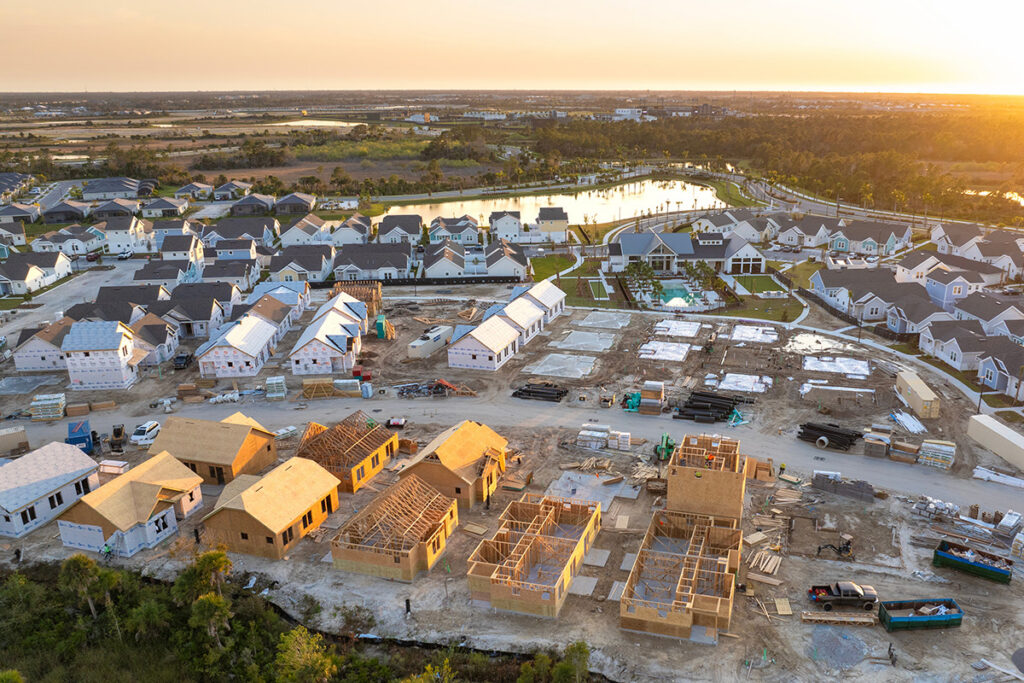
Against this backdrop, build-to-rent (BTR) has emerged as a popular residential style. These master-planned communities consist of units purpose-built for leasing. These units typically resemble traditional single family rental properties (SFR), with detached houses boasting features like private yards and garages. However, BTR properties are operated like multifamily assets. Professionally managed by larger ownership groups, they often provide classic multifamily amenities like pools, clubhouses, and on-demand maintenance that intentionally cultivate a shared neighborhood experience.
In recent years, BTR has grown from a niche concept to a significant component of the rental landscape. Builders delivered an estimated 97,000 BTR units in 2023, a 45 percent increase over the previous year. Additionally, BTR represented nearly 8 percent of single-family housing starts in 2023. For both developers trying to meet a nationwide demand for affordable housing and renters looking to affordably enjoy the quality of life offered by single-family homes, BTR provides a compelling alternative. Furthermore, these developments offer unique opportunities for placemaking and community stability, which can strengthen local identity and benefit the jurisdictions in which they are located.
RENTERS
For some, renting is a matter of preference. Without being tied to a fixed asset, renters have more freedom to move and adapt to changing life circumstances. Certain renters may prefer “access over ownership,” with denser rental properties providing close proximity to transportation, employment centers, and entertainment opportunities. Others rent out of necessity, with many would-be homebuyers hampered by debt, mortgage requirements, or limited capital for a down payment and closing costs.
To both groups of renters, the draws of BTR are numerous. It is a low-risk way for aspiring homebuyers to test out a community before committing to ownership, and older or disabled consumers may be attracted to the reduced need for upkeep and maintenance when compared to homeownership or traditional SFR. To renters who desire the space of a single-family home, BTR layouts can provide flexibility for features like a home office or nursery. Tenant retention of BTR is characteristically high, indicating existing renters’ approval of the property type. This satisfaction is exemplified by one-off sales sometimes offered to long-term tenants.
For many, the primary drawback of renting remains the inability to build equity. Financial security and homeownership have long been synonymous in American society, and renters are often excluded from this traditional wealth-building pathway. However, BTR offers a different kind of value by providing the social benefits of a neighborhood without the financial barriers of a mortgage. In offering the physical layout of a single-family neighborhood—complete with yards, sidewalks, and front porches—this model allows families and professionals to build social ties and enjoy the sense of place created by stable neighborhoods and long-term residents, which more transient apartment living often lacks. At the same time, the growth of purpose-built rental communities raises an important question for housing policy: whether increased investment in BTR could compete with efforts to expand the supply of attainable homes for sale.
INVESTORS
The market opportunity BTR presents for developers and investors is clear, but there are other draws to the property type for these groups. Concentrated BTR neighborhoods are typically easier to manage than scattered portfolios of single-family rentals, making them relatively efficient assets to operate. Additionally, high tenant retention—driven by homes designed around comfort and community-oriented amenities—supports consistent cash flow for owners, especially compared to the short-term sales and slower absorption of sold units. When residents stay longer, they are more likely to transition from temporary occupants to active community participants, creating an alignment of interests between investors and residents.
For builders, BTR also provides flexibility. Developers may choose to lease units, sell to institutional investors, or pursue a hybrid approach, allowing them to navigate uncertain housing sales cycles. Notably, both the January 2026 executive order restricting institutional investment in single-family homes and the recently passed bipartisan housing bill allow institutional ownership of BTR communities. These measures reinforce the model as a pathway for institutional capital to support new housing supply without directly competing with individual homebuyers, although the bill’s provision requiring the sale of these homes to individuals within seven years of completion could represent a long-term threat to the BTR model.
There are additional questions about how BTR fits within existing zoning frameworks. A January 2025 ranking of the top US metros by number of BTR units in the pipeline shows the Sun Belt region leading this property type’s growth. All ten of the top-ranked metros are in the region, with Phoenix, Dallas, and Atlanta at the top. In these top MSAs, zoning regulations are significantly more restrictive for middle and high-density housing options, like duplexes and apartments, than for single-family homes. In Phoenix, for example, single-family units are allowed by right in 77 percent of residential land, while two-family units are inherently allowed in only 9 percent. A similar pattern can be observed in all eight of these top ten markets reporting zoning info to the National Zoning Atlas. Developers face an easier path to single-family than multifamily construction in these markets given the limited availability of land designated for multifamily use.
Share of Residential Land Allowing Housing Unit Types As of Right
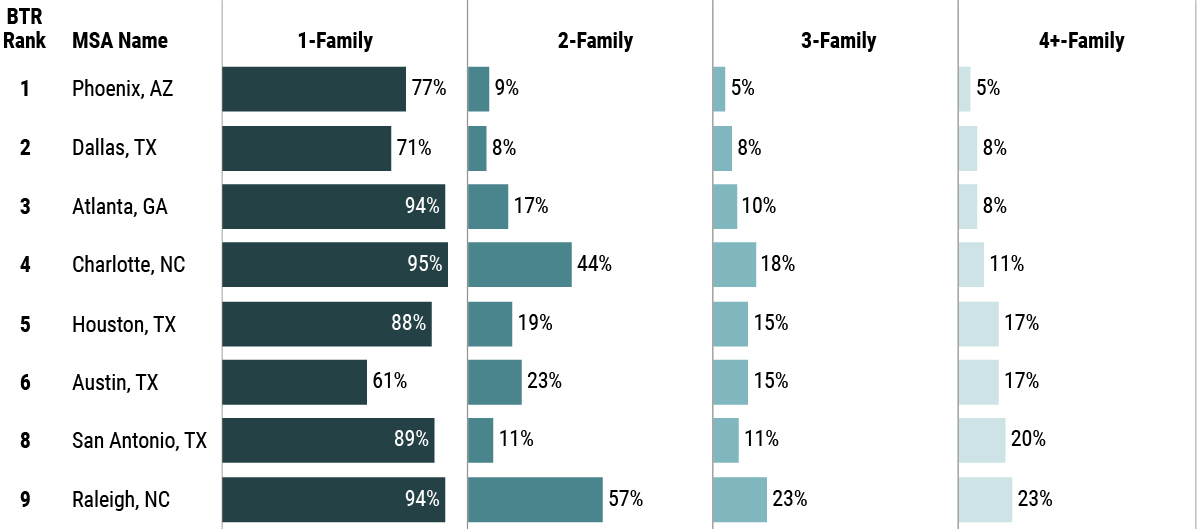
Sources: National Zoning Atlas, Zoning Snapshots; Point2Homes; TIP Strategies, Inc.
Notes: Zoning Snapshot data is unavailable for the Orlando, FL, and Huntsville, AL, MSAs, the 7th and 10th ranked MSAs, respectively, by number of BTR units in the pipeline according to Point2Homes. Jurisdictions with no zoning are excluded from this analysis.
Residential districts have historically been separated by ownership type in the US, and anti-renter bias and “not in my backyard” opposition frequently characterize discussions around multifamily development. Though it may generate less pushback than traditional multifamily, the unique character of BTR has prompted discussions around its proper zoning classification. In metro Atlanta, several jurisdictions have enacted land use ordinances to restrict or outright prohibit BTRs in single-family zones, despite BTRs being commonly single family themselves. The application of single-family parking minimums and the need for operational assets like leasing offices can also create conflict. While the number of jurisdictions that have explicitly banned BTR is few, so is the number of jurisdictions that have updated their zoning code to explicitly allow it. BTR doesn’t fit neatly into one category, and how localities interpret the property type legally will shape the future of purpose-built rentals in the coming years.
LOCAL JURISDICTIONS
For cities, counties, and other government jurisdictions, the housing affordability crisis represents a threat to long-term growth. In some localities, growing populations and antiquated zoning restrictions mean that local housing supply will inevitably be outstripped by demand unless zoning is updated to explicitly allow higher density options.
Beyond increasing housing stock, BTR communities offer these jurisdictions placemaking benefits. Noted previously, BTR can provide easy access to leisure options that renters would otherwise not have in a single-family home. Best practice BTR communities integrate multiuse trails and central green spaces into their design to create opportunities for social interaction, improving the renter experience and providing amenities that cities desire. Such communities can create homes people enjoy for reasons beyond the convenience of location.
Residents who are happy, healthy, and involved are more likely to take good care of their local environment, strengthening community resilience. This reflects a core tenet of placemaking. Happier renters are also more likely to stay longer, and the typically low turnover of BTR suggests that these developments encourage residents to invest in their community in the long term. The fact that BTR rapidly moves many people into one area at once can uniquely boost placemaking, creating a melting pot of diverse residents. Additionally, given its ability to locate in denser areas with relative ease compared to traditional single family housing, BTR can represent a powerful tool for urban revitalization, bringing enhanced quality of life to these areas through community-focused amenities.
The growth of the build-to-rent model suggests that this property type is more than a temporary market fix; it reflects a shift in how many households seek attainable, high-quality housing and community. With its flexibility and emphasis on shared amenities, BTR can offer jurisdictions a powerful tool for expanding housing choices for a diverse range of renters while fostering a sense of place and belonging. Still, it is not a singular solution to the nation’s housing affordability crisis. Local leadership will play a critical role in shaping how BTR fits within zoning frameworks and broader housing strategies—balancing long-term pathways to ownership with market demand for places where residents can put down roots and build the social infrastructure that sustains strong communities.